Our research is important for many reasons. It helps us understand how the developing mind works, how biology and experience shape our lives, how caregivers can best support children’s development, and how we can help children at-risk for poor developmental outcomes. Our main goal is to develop a scientific understanding about how children develop, but our science is useful beyond the geographic and digital borders of universities: it helps us figure out how to improve children’s developmental outcomes.
We wish to acknowledge that the land on which we gather to work, study, and learn is part of the unceded territory of the Nanticoke Lenni-Lenape Tribal Nation.
Our Studies
-
How do young children learn language?
-
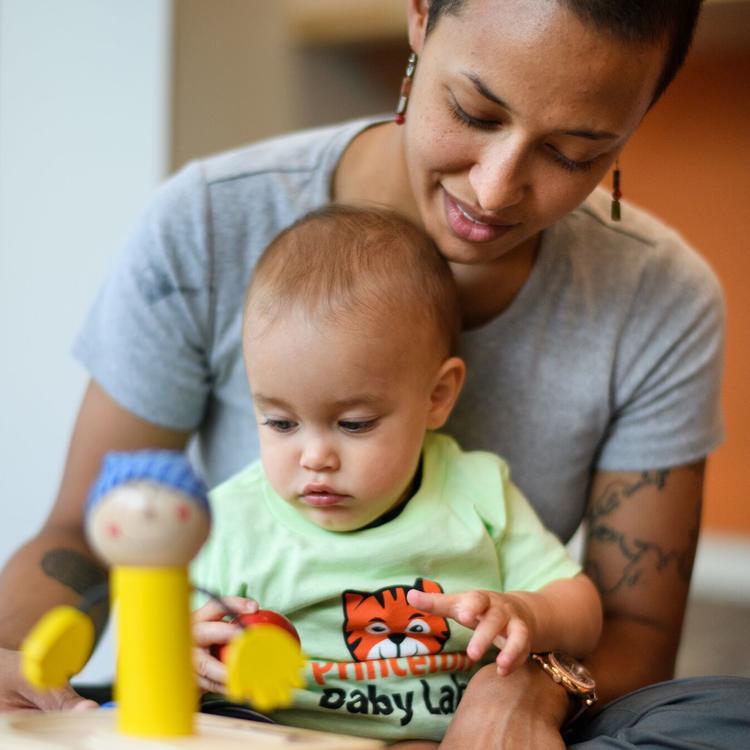
Babies and toddlers have an amazing ability to learn language, in part because they spend a lot of time listening, looking, and interacting with caregivers. Our lab aims to understand language learning by studying how learning mechanisms and the environment interact to shape language outcomes.
Each young child’s ability to process language in real time is rooted in and shaped by their experience. Our studies aim to look at this through simulations of a child’s language experience. In addition to this, we study children from different socioeconomic backgrounds and adults learning a second language. We combine methods from Psychology, Linguistics, and Communication Sciences & Disorders. During our studies, we measure simple behaviors like eye and head movements, attention, and communication with others. We ultimately hope for our work to provide a link between research and clinical practice.
-
How do bilingual children learn two languages?
-
Many children in the United States and around the world grow up bilingual, and over time they learn about the sounds, words, and sentences used by members of their family and community. But how do they accomplish this, given that they hear a constant mix of two languages? In this line of research, we investigate how babies and toddlers break into the complexities of bilingualism, and how caregivers can best support the learning of two languages.
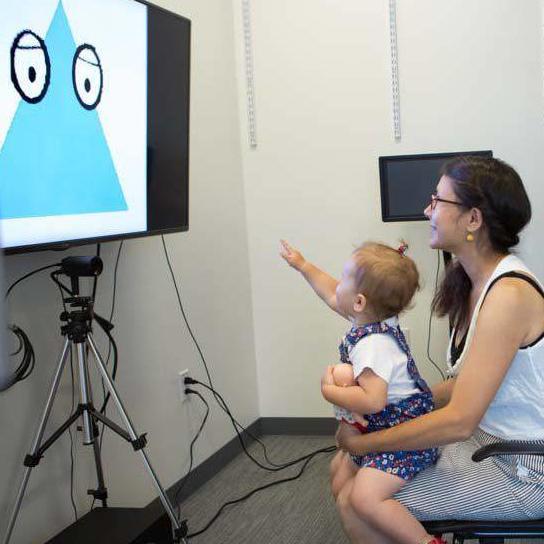
In our studies, we record babies’ and toddlers’ eyes as they look at pictures and listen to bilingual sentences. It’s kind of like watching TV for a few minutes. Learn more about our research methods.
-
How do babies learn to see the world around them?
-
Seeing is so easy for adults: We just open our eyes! But this is not an ability that we’re born with: babies must learn how to see, hear and get information about the world through their senses. In this line of research, we investigate how a baby’s ability to learn helps them see. How does learning about something new help them to see it better?
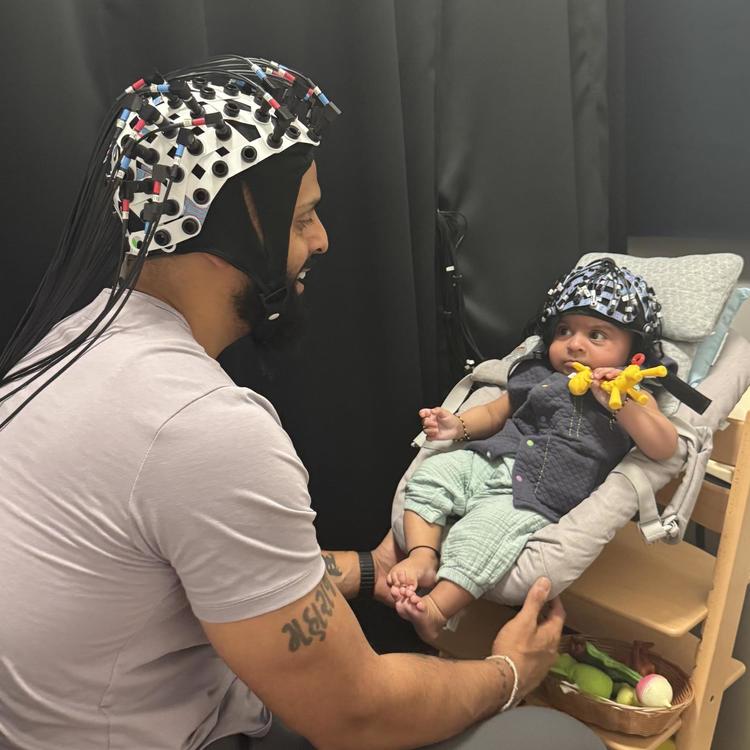
We’ve found that in as few as a couple of minutes, a baby can learn to change their visual system (the part of the brain that processes visual information). We are uncovering how fast and flexible a baby’s brain is by using a method called functional near-infrared spectroscopy (fNIRS) which is entirely safe, FDA-approved and comfortable for infants. Learn more about this research method.
Participate
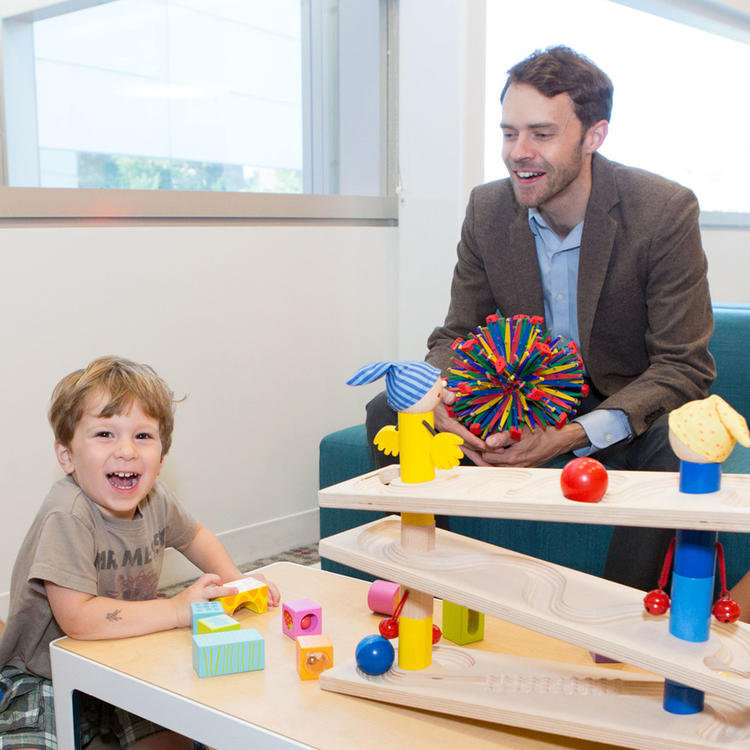
Our studies are designed to be fun and engaging for your child! Appointments are usually 30-45 minutes long. Studies usually entail your child hearing sounds or seeing pictures or a play session with one of our researchers. During some studies we will video tape your child so that we can watch and determine what your child learned from the study.