
Measuring eye movements
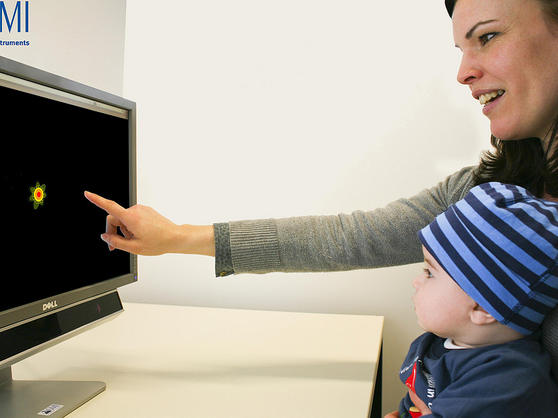
In some of our studies, we measure children’s eye movements to help understand how they learn. For example, we might have children sit in front of a big screen showing pairs of pictures (such as a dog and cat) and listen to a sentence referring to one of the pictures (such as “Look at the doggy!”). In this kind of study, we take a video of children’s eyes as they look and listen, which lets us measure the amount of time they spend looking at the correct picture. For other studies, we use an eye tracker (a special camera and computer model) plus a small sticker on the child’s forehead to automatically track exactly where children are looking on a computer monitor. Studies usually last 5-8 minutes, and we choose pictures and sentences that are fun for kids.
Child-friendly brain imaging
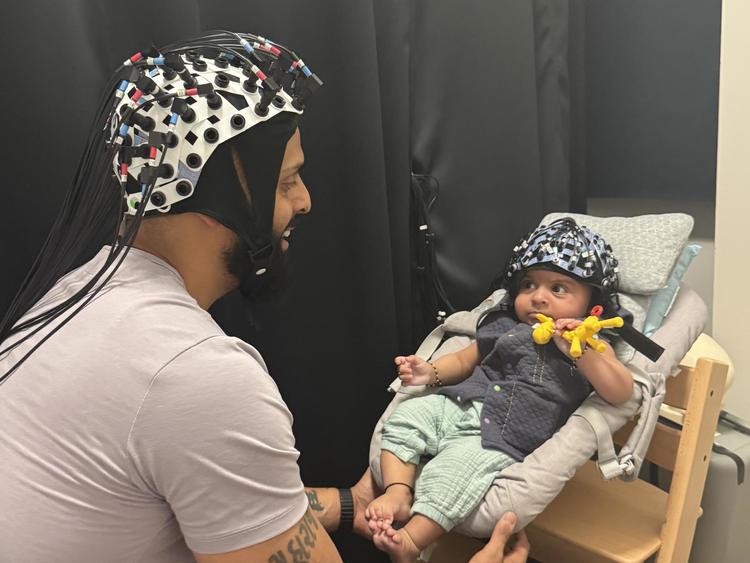
In some of our studies, we want to understand what's happening in young children's brains as they learn and interact with the world. To do that, we use near-infrared spectroscopy (fNIRS), a child-friendly brain imaging technology. It works by shining light onto the head and measuring its reflection, which allows us to see what parts of the brain are active when someone is listening, looking, speaking, or learning. This technique is safe for children and involves less exposure to near-infrared light (a special kind of light we can’t see) than going outside for a few minutes on a sunny day. Unlike other brain-imaging methods that require participants to stay very still, fNIRS can be used while young children move around freely. We use light-weight and comfortable caps that are made for babies and toddlers. They often don't even notice it's there! We are also interested in what's happening in caregivers’ brains as they talk to or play with their children, so we sometimes use fNIRS to record brain activity in adults and children at the same time.
Vocabulary questionnaires
We often want to know how many words kids have learned at different ages. When you visit the lab, we may have you fill out the MacArthur-Bates Communicative Development Inventory, a checklist containing hundreds of nouns, verbs, adjectives, and more. The questionnaire takes a little while to fill out, but our research assistants are here to entertain your kid(s) while you’re occupied.
Interactive games
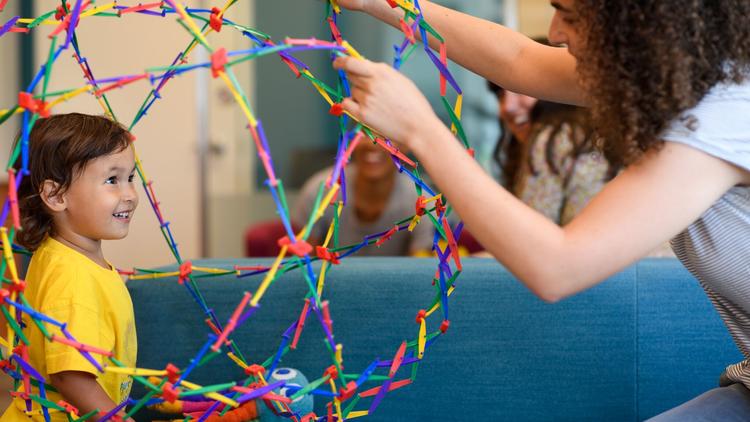
Some of our studies involve short interactive games that young children play with a researcher and/or their caregiver. These games can take many different forms—sometimes they are computer-based or tablet-based, and other times they involve playing with new toys or objects that children haven't seen before. The goals of these games vary, but we often measure children’s word/concept learning, curiosity/exploration, attention, and memory, while keeping the activities engaging and fun, with opportunities for children to earn small prizes or stickers along the way.
Recording parent-child interactions
While most of our research takes place in the lab, children’s real-life learning and development takes place in the full, fun, messy world! To understand what a typical day of home language experience looks like, we sometimes ask families to record their interactions using a small audio recorder called a LENA. We use these day-long, child-centered recordings to ask a range of research questions: How often do children hear multiple languages? How do parents and children interact in different contexts?
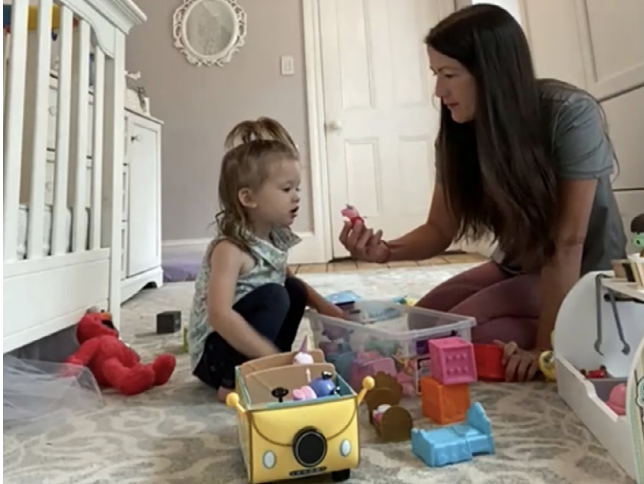
For other studies, we turn on video cameras and record families interacting and playing. Sometimes we do this for just 10-15 minutes in the Baby Lab, and sometimes we ask families if we can record natural interactions in the home. This is an important part of developmental research — while experiments can give us insights about causation, it’s also crucial to observe children’s real lives. With these recordings, we often use computational methods to understand behaviors we’re interested in.