Children are curious explorers, actively engaging with the world around them. At the same time, their social world provides scaffolding to support their learning: for example, caregivers may draw children’s attention to new pieces of information, like how a tool works or what to call an unfamiliar object. In this study, we asked how children’s active curiosity and parents’ scaffolding work together to boost early learning.
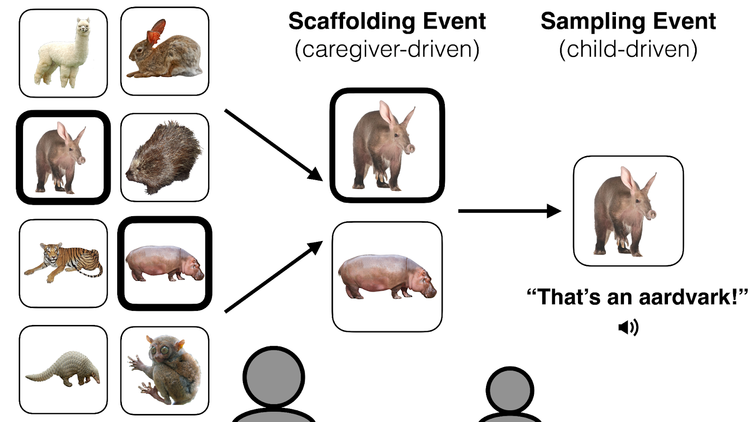
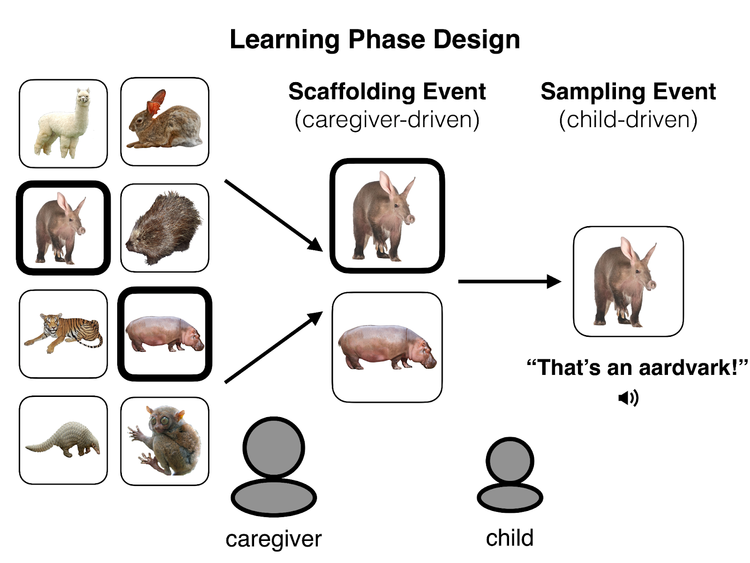
To investigate how both children and parents actively contribute to word learning, we designed a word learning game in which parents and children independently control different parts of the learning process. In the game, children have the opportunity to learn the names of animals. Some are words that children already know very well (e.g., “tiger”), some are words they may never have heard before (e.g., “aardvark”).
In the first part of a learning event (the Scaffolding Event), parents can either choose which two animals children might learn about next, or the animals are chosen randomly. Next, in the Sampling Event, children can either choose which animal they learn the name for, or children passively observe one of the two animals being chosen at random. In this design, we can independently control whether caregivers and children are actively in control of what they learn about next, or whether they are passive observers.
We found two key results. First, parents spontaneously draw children’s attention to more unfamiliar words when they can actively control the input. This is important because children were less systematic in choosing unfamiliar words until they approached five years of age. Parents were instrumental in helping children encounter new words in their learning curriculum. Second, children learned best when they could make active choices about what they learned about next — children are most effective learners when they are active learners. Together, we think these results show that active engagement from both caregivers and children play crucial roles during early learning, by helping children focus on new information.
Researchers: Martin Zettersten and Casey Lew-Williams